 Logx
Logx outlined a dedicated Orderly terminal alongside OG pools in 2024
Logx outlined a dedicated Pro terminal in February 2024 for perpetual futures trading through an Orderly Network orderbook. The design separated that route from the OG app’s pool-based markets and excluded Hyperliquid from Pro’s stated liquidity sources. Existing Orderly activity through the Logx aggregator was meant to remain visible in the new terminal, while positions elsewhere followed different arrangements. The announcement scheduled March 5, 2024 for launch. A later sunset notice announced the end of new positions and a September 2025 withdrawal cutoff, changing access to the legacy trading platform.
· last updatedKey takeaway: The 2024 Pro plan promised continuity for balances and history from the Logx aggregator’s Orderly integration, while positions on other protocols followed separate closure instructions.
What changed for existing Orderly traders in 2024?
Users of the Logx aggregator’s Orderly integration were promised continuity for their balances, open trades and trading history within the planned Pro terminal. The February 24, 2024 announcement scheduled a March 5 launch and said the older app would retain Orderly trading until that transition. It described prompts directing users to Pro, where their open Orderly trades would appear. Those assurances concerned activity already handled by Orderly Network. They didn’t describe a universal transfer of positions from every protocol that the earlier aggregator had used.
The planned navigation also separated the two products. A Pro prompt on the website and an Orderbook tab with a Pro badge in the OG app were intended entry points. These were the access arrangements described for the 2024 rollout, before the later trading-platform sunset.
Orderly liquidity and the former aggregator
Logx’s original aggregator had started with GMX and MUX on Arbitrum, then added Gains, Hyperliquid and Orderly. Pro’s advertised role was narrower: it would remain a broker frontend for Orderly. The February 2024 Pro announcement assigned its initial orderbook liquidity exclusively to Orderly Network.
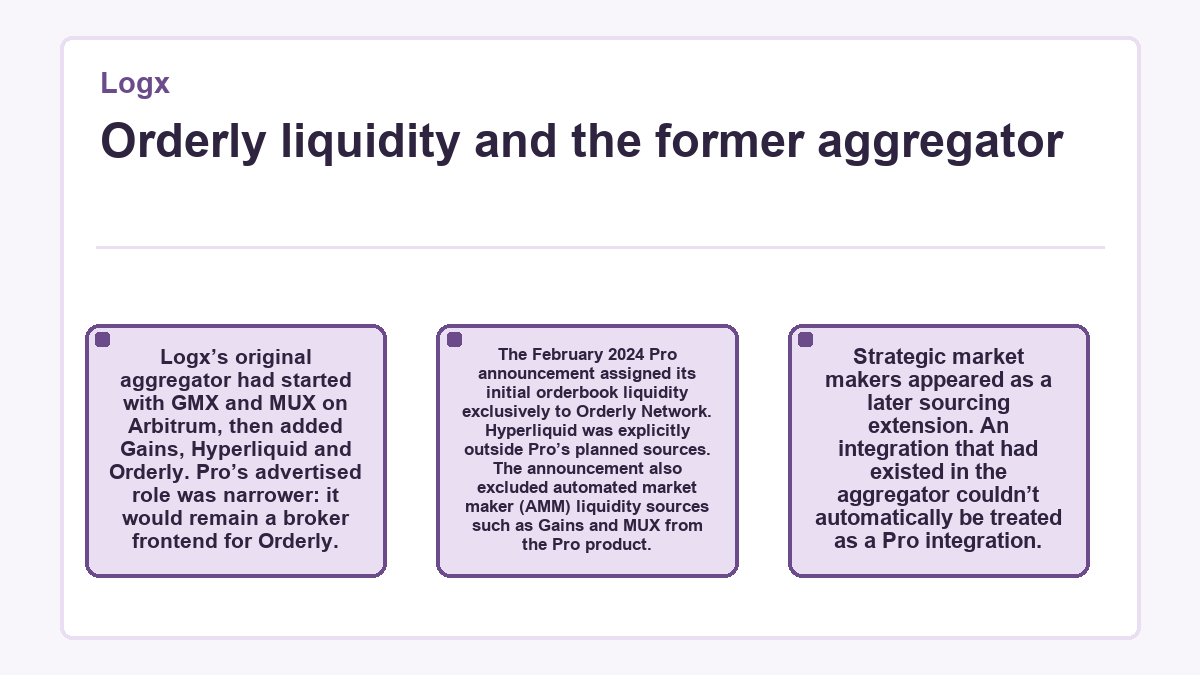
Hyperliquid was explicitly outside Pro’s planned sources. The announcement also excluded automated market maker (AMM) liquidity sources such as Gains and MUX from the Pro product. Strategic market makers appeared as a later sourcing extension. An integration that had existed in the aggregator couldn’t automatically be treated as a Pro integration.
Arbitrum and Optimism as the initial entry chains
Pro’s announced deposit plan started with Arbitrum and Optimism, the same networks through which the aggregator had offered Orderly access. OG pool deployments followed another map: the February article listed Mantle, Manta, Linea, Mode, Kroma, Telos and Fuse. Those pool deployments didn’t expand Pro’s announced entry-chain list. Planned expansion to Blast and Arbitrum belonged to the OG roadmap in that document. The two references to Arbitrum concerned different paths: existing Orderly access and a proposed OG pool deployment.
How did Pro’s orderbook differ from OG pool trading?
Pro’s announced design called for an Orderly orderbook, while OG’s DAMN pools supported oracle-based perpetual futures. DAMN stood for Discrete Asset, Market Neutral. The pool documentation described USDC and USDT collateral, with profit and loss settled in the selected collateral token. Liquidity providers supplied those stablecoins and received LLP tokens. Trader gains drew from the pool, while losses added to it. The two paths also had separate trading fee structures.
The announced terminal tools
Pro’s announced terminal tools combined order matching with gasless transactions in the Orderly-based trading design. The February 2024 Pro announcement advertised latency below 25 milliseconds. It paired that speed claim with a claim of tight spreads.
Cross-margin support was another part of the Pro feature list. Cross margin uses shared collateral to support multiple positions. Losses on one position can therefore affect the collateral that supports others. That margin relationship differs from the network used to deposit.
TWAP and VWAP appeared as advanced order types. TWAP expands to time-weighted average price, while VWAP means volume-weighted average price. These execution methods use time or trading volume as their reference.
An API stack and on-demand addition of exotic trading pairs formed another part of the announced feature set. The API concerned software access to trading, while pair additions concerned the range of markets.
The planned integrations ranged from strategy tools driven by signals and alerts to Telegram bots and autonomous trading agents. The same list included community-driven vaults. These categories accompanied Pro’s terminal features; the announcement didn’t define each integration’s implementation or assign it a separate release date.
An Orderly route and a Mode pool trade
In a hypothetical comparison of the announced 2024 setup, a trader who’d used the Logx aggregator’s Orderly integration wanted Orderly execution and continuity for the associated trading history. The choice was between the Orderly route through Arbitrum and an OG pool trade on Mode.
The Orderly route through Arbitrum matched the stated Pro design and its assurance about existing Orderly interactions. A Mode pool trade belonged to OG’s oracle-based offering. Only the former fell within the announcement’s Orderly-history continuity promise; that assurance didn’t cover importing the Mode pool trade into Pro. This comparison concerned the 2024 design, before the later shutdown changed legacy trading access.
Positions outside the Orderly route
Existing positions on Hyperliquid, Gains and similar platforms had a different closure route from the proposed Orderly continuity arrangement. The February 2024 announcement directed their holders to the underlying platforms’ own interfaces to close them. It didn’t establish that every position formerly opened through the aggregator would appear in Pro, or that Pro would supply the controls needed to close it.
The aggregator’s common screen had brought several protocols together without turning them into a single position system.
Reward points across the product split
Points already earned toward LOGX rewards were meant to survive the proposed division between the OG and Pro products. That assurance concerned incentive records, distinct from the promise of visibility for Orderly balances and trade history.
Pro trading also appeared in the announcement as an activity that would qualify users for LOGX airdrop rewards. OG and Pro were to share the LOGX reward token. That token-level continuity was separate from the rules for earning further LOGX airdrop rewards, which the project reserved for a subsequent rewards-programme announcement.
The later shutdown of legacy trading
The later Operational Update announced sunset mode for the perp DEX and the end of new position opening. The launch-era access instructions predated that restriction.
Withdrawal handling also changed. The shutdown reminder said post-cutoff requests would require manual support and face significant delays. Its earlier instant-processing assurance concerned requests before the cutoff. The Logx trading-platform shutdown reminder set its withdrawal cutoff for September 10, 2025 at 13:00 UTC.
What readers ask about Logx
Did gasless Pro trading eliminate maker and taker fees?
Pro’s advertised gasless experience didn’t remove its separate trading fees. The legacy fee schedule listed 0.06% for taker orders and 0.03% for maker orders as Pro position fees. Those historical rates belonged to Pro; OG pool trading followed a different fee schedule.
Did Pro guarantee order execution within 25 milliseconds?
The February 2024 announcement advertised latency below 25 milliseconds, without establishing a deadline for every order’s execution. It didn’t specify an end-to-end timing guarantee for deposits, trades or withdrawals.
Could Pro’s announced airdrop eligibility determine a fixed reward per trade?
Pro’s announced airdrop eligibility didn’t define a fixed LOGX reward per trade. The February 2024 article reserved detailed reward rules for a separate programme update. It preserved previously earned points without providing a conversion rate from points into tokens.
When was the old points system scheduled to expire?
The February 24, 2024 Pro announcement scheduled the existing points system to expire on March 5, 2024, while preserving previously earned points and promising details of the new rewards programme on the same date.
Were USDC and NFT campaign rewards the same as LOGX airdrop rewards?
The Pro announcement described campaign rewards separately from its LOGX airdrop eligibility statement. It listed USDC, rare Logx NFTs, Orderly NFTs and L2 tokens such as ARB and OP among campaign reward types. Those were historical campaign categories, without a fixed recurring payment for every trade.