 Logx
Logx liquidity pools linked OG trader PnL to shared stablecoin balances
Logx liquidity pools backed legacy LogX OG perpetual trades with stablecoin reserves that gained from trader losses and paid trader profits. In the documented USDC and USDT model, traders settled profit and loss in their collateral token. Liquidity providers supplied those reserves and received LLP, exposing their contribution to the pool’s trading outcomes. The later trading sunset disabled new positions and changed withdrawal handling.
· last updatedBottom line: An LLP balance represented participation in an OG pool; LOGX staking terms described a separate asset and product.
Settlement between collateral and the pool
In the documented USDC/USDT model, an OG trade used either token as collateral, and settlement changed the pool’s balance in that same token. Position size described the leveraged exposure; collateral described the trader’s committed funds. Profit and loss, shortened to PnL, measured the trading outcome.
Collateral and settlement currency
USDC-collateral trades settled PnL in USDC, while USDT-collateral trades did so in USDT. A position’s index token identified its price exposure. It didn’t turn the stablecoin settlement into delivery of the underlying asset, so a market’s name and its settlement currency described different things.
Opposing balance movements
Trader profits
In the legacy OG model, the pool paid trader profits from its stablecoin reserves. The profit component reduced the pool’s balance. The trader’s returned collateral was a separate component of the payout, so a total payout wasn’t all profit.
Trader losses
A losing position transferred its loss to the pool, increasing the reserve balance in the same collateral token. Position charges and other costs also affected the trader’s final balance.
How did one reserve support different perpetual markets?
The legacy OG design reused stablecoin liquidity across its listed index tokens. Positions referenced different markets while drawing on liquidity in their collateral tokens. The pool didn’t need a separate inventory of every underlying asset. Available stablecoin reserves constrained total trading capacity, and per-index limits separately restricted how much exposure traders could open in one market.
Collateral, LLP and LOGX token roles
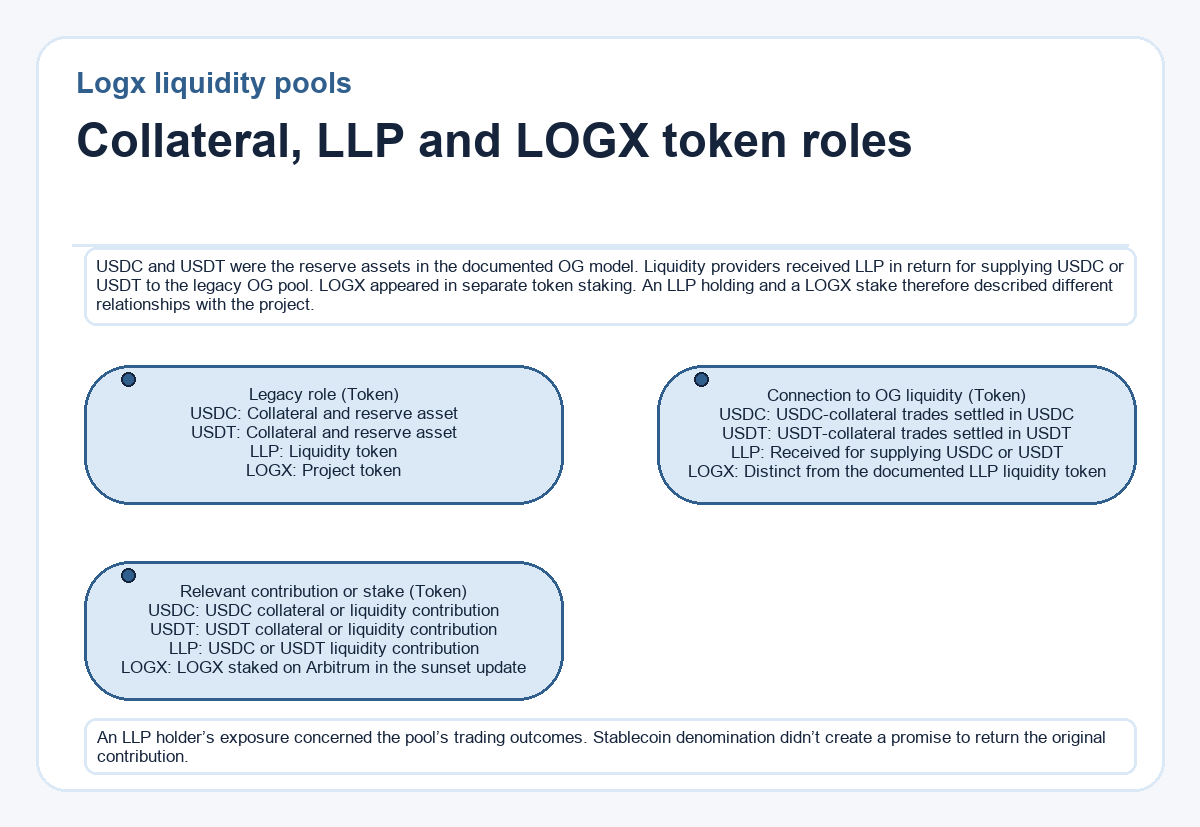
USDC and USDT were the reserve assets in the documented OG model. Liquidity providers received LLP in return for supplying USDC or USDT to the legacy OG pool. LOGX appeared in separate token staking. An LLP holding and a LOGX stake therefore described different relationships with the project.
| Token | Legacy role | Connection to OG liquidity | Relevant contribution or stake |
|---|---|---|---|
| USDC | Collateral and reserve asset | USDC-collateral trades settled in USDC | USDC collateral or liquidity contribution |
| USDT | Collateral and reserve asset | USDT-collateral trades settled in USDT | USDT collateral or liquidity contribution |
| LLP | Liquidity token | Received for supplying USDC or USDT | USDC or USDT liquidity contribution |
| LOGX | Project token | Distinct from the documented LLP liquidity token | LOGX staked on Arbitrum in the sunset update |
An LLP holder’s exposure concerned the pool’s trading outcomes. Stablecoin denomination didn’t create a promise to return the original contribution.
Oracle pricing and limits on pool exposure
OG’s oracle-based design supported leveraged exposure against pooled assets without an orderbook for every index token. Its pricing mechanism therefore mattered to the pool’s PnL.
Aggregated prices
The pricing mechanism gathered prices from centralized and decentralized venues to form a median. It compared the aggregate with Pyth prices on chain and wrote the price to chain.
Exposure controls
Open interest measured exposure in positions that remained open. The design imposed maximum open-interest controls and caps on long and short sizes for each index token. It also sought to reduce each market’s long-short imbalance. These controls constrained position availability alongside the amount of stablecoin liquidity.
A separate cap limited each trade’s profit in the legacy specification. Permitted profits still came from pool assets, so the cap restricted the size of that obligation while leaving the trader-pool PnL relationship in place.
What did the trading sunset change for OG liquidity?
The operational update disabled new perpetual positions and placed the legacy trading platform into sunset mode. The pools’ earlier role as trading liquidity belonged to that legacy system.
The trading-platform withdrawal cutoff was September 10, 2025 at 13:00 UTC. The shutdown reminder said withdrawals after that cutoff would require manual support intervention and face significant delays. Its earlier instant-processing statement applied to requests before the cutoff, so it wasn’t a completion promise for later requests.
Current redemption access for an individual OG pool remains unconfirmed. The notices addressed trading-platform withdrawals without setting out a pool-by-pool LLP settlement schedule. That leaves LLP holders with a pool-specific exit question, beyond the general trading cutoff.
Charges beside the pool’s PnL
OG trader charges affected account balances beyond the profit or loss that changed pool reserves. The legacy position fee used position size as its base and came from collateral. Borrowing charges accrued while positions remained open and came due when a position increased or decreased. Funding moved from the side with greater exposure to the side with less exposure. Keepers collected execution charges for carrying out requests. Adding these charges together required the position’s actual activity and applicable rates.
DAMN deployments and historical network scope
The DAMN expansion started on Mantle in December 2023. The February 24, 2024 Pro announcement listed OG DAMN pools on Mantle, Manta, Linea, Mode, Kroma, Telos and Fuse. DAMN stood for Discrete Asset, Market Neutral. These were native pool-based perpetual products, alongside the separate Orderly-backed LogX Pro design.
The narrower OG overview described USDC and USDT reserves. The broader DAMN announcement included USDT, USDC and wUSDM among stable assets that pools could accept. That description didn’t assign an identical asset mix to every deployment. An existing LLP holder needs the redemption terms for their original pool and network before choosing an exit route.
Common questions, answered
Could an OG DAMN pool trade also count as an Orderly trade?
A native OG DAMN pool trade used the pool-based perpetual system. The Orderly route in the February 2024 product split belonged to the planned Pro terminal. These were distinct trading systems, so activity against an OG pool didn’t by itself establish activity through Orderly.
Did OG’s 0.1% position fee represent an LLP payout?
The 0.1% figure described the legacy trader position fee, not an LLP payout rate. OG charged it on position size when a position opened or closed and deducted it from collateral. That charge alone didn’t specify the share of fees, if any, distributed to an individual liquidity provider.
Were Blast and Arbitrum already in the February 2024 DAMN deployment list?
The February 24, 2024 announcement treated Blast and Arbitrum as planned DAMN expansions, outside its list of existing deployments. Its statement about coming weeks expressed a plan. It didn’t establish an actual launch date, later availability or withdrawal terms for a pool on either network.
Did the Arbitrum staking deadline apply to LLP tokens?
The Arbitrum instruction concerned LOGX stakers, who were told to withdraw before September 10, 2025. The update set that staking module’s annual percentage rate to 0% and scheduled its retirement. That instruction governed LOGX in the staking module; it wasn’t a universal LLP redemption deadline across OG pools.
Did the legacy OG documentation’s pool example include liquidation?
The simplified OG pool illustration explicitly excluded liquidation. The legacy fee schedule separately specified a protocol liquidation charge equal to the greater of $2 or 500 basis points of position size. That percentage used leveraged position size as its base. The simple PnL illustration didn’t calculate this additional charge.